
Nov
08
A Six-Herb Formula Turned Down Three Inflammatory Switches at Once in Aging Kidneys
0 Comments
Inflammatory aging in tissue runs through three signalling switches that feed each other. A six-herb formula in clinical use for kidney disease turned down all three in aged mice, and the researchers took the extra step of checking which of its components actually reach the bloodstream.
The short version
When a cell becomes senescent it starts broadcasting. That broadcast, the senescence-associated secretory phenotype or SASP, is what makes senescent cells harmful to their neighbours, and it is generated by three signalling systems working together:
- STAT3, which carries inflammatory cytokine signals into the nucleus
- NF-κB, the master inflammatory transcription switch
- NLRP3, the inflammasome that matures IL-1β and sustains the loop
Each one amplifies the others. Suppressing one leaves two running, which is a plausible reason that single-target anti-inflammatories have been disappointing against tissue aging.
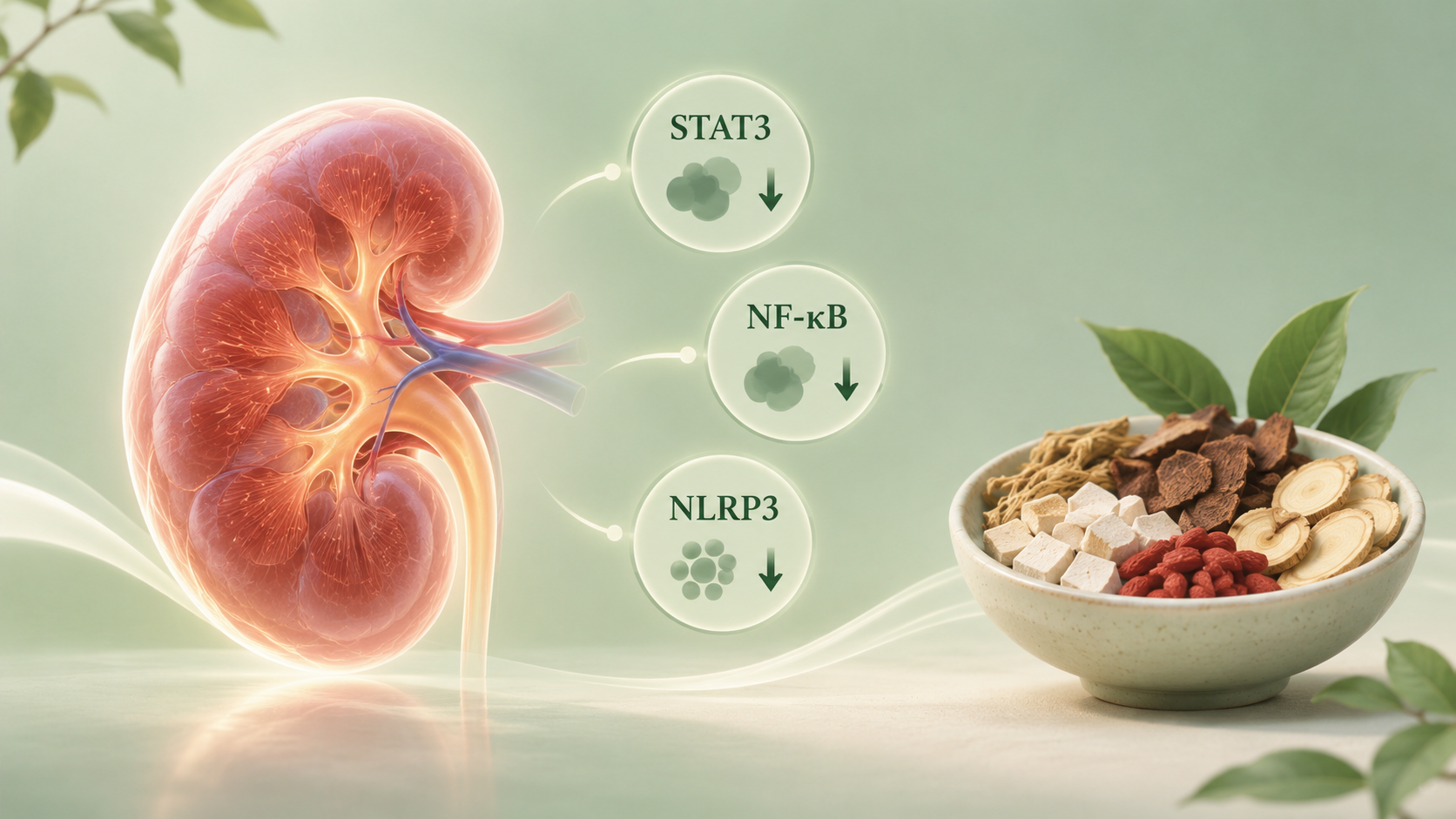
Kai Wen and colleagues tested the Huyan-I formula, a patented six-herb traditional Chinese preparation used clinically at Jiangsu Provincial Hospital of TCM for early-stage chronic kidney disease. In naturally aged mice and in human renal tubular cells pushed into senescence, the formula reduced senescent cell burden and senescence markers, suppressed all three of STAT3, NF-κB and NLRP3, lowered SASP expression, and improved tubular injury and fibrosis. Resveratrol was run alongside as a positive control (Wen et al., 2026).
What to do with that: this is a prescription formula, not something to source, and nothing here is a reason to take it. The usable part is a test you can apply to any product you are considering. The study identified 211 components in the formula but found only 29 of them in the blood of treated animals. Ask of anything you buy: how much of what is on the label has ever been shown to reach circulation. A supplement that lists a long botanical blend with no absorption data behind it is telling you about its contents, not about its effects, and the gap between those two numbers here is roughly seven to one.
Why three switches instead of one
The anti-inflammatory compounds sold for aging almost all target a single node, usually NF-κB. The reasoning is sound as far as it goes, since NF-κB sits behind a great deal of inflammatory gene expression.
The problem is that the three systems above are not arranged in series. STAT3 can be activated by cytokines whose production NF-κB drives, and the products of NLRP3 activation feed back into both. Suppress NF-κB alone and the other two continue to supply the inputs that restart it. The loop has redundancy built in, which is exactly what you would expect of a defence system that evolution did not want switched off by a single failure.
That redundancy is useful in an acute infection and unhelpful in chronic low-grade inflammatory aging, where the loop runs without an infection to resolve. It is also a clean illustration of why multi-target intervention is not a marketing frame but a structural requirement for certain problems. Some systems cannot be moved from one point.
What the study did
The work has three parts, and the middle one is the reason we are writing about it.
Chemistry. UPLC-Q-TOF-MS analysis identified 211 components in the formula. That is a typical number for a multi-herb preparation and by itself means little.
Serum pharmacochemistry. The team then dosed mice and looked at what was in their blood. They found 29 prototype compounds and 19 metabolites. This step is skipped far more often than it should be, and it is the difference between describing a plant and describing an exposure. Only what reaches circulation can act on a distant tissue.
Target prediction and testing. Network pharmacology and molecular docking pointed at the STAT3/NF-κB/NLRP3/SASP axis. The formula was then tested in naturally aged mice and in HK-2 human renal tubular cells made senescent with D-galactose, against resveratrol as a positive control. Readouts included Western blot, immunohistochemistry, multiplex immunofluorescence, and HE, Masson and PAS histology.
Senescent burden fell, all three switches were suppressed, SASP expression dropped, and tubular injury and fibrosis improved.
Naturally aged mice, not an accelerated model
The animal work used naturally aged mice. That is worth separating from the much commoner practice of inducing an aging-like state chemically and treating that.
Accelerated models are quicker and cheaper and they answer a narrower question. A compound that protects against D-galactose has shown it can counter one specific insult. A compound that improves tissue in an animal that simply got old has been tested against the actual thing. The cell arm here used the induced model and the animal arm did not, which is a reasonable division of labour.
What a positive control tells you
Running resveratrol alongside is a choice we would like to see more often. Resveratrol is the most studied single polyphenol in this space, it has known activity against these pathways, and putting it in the same experiment gives the formula something to be measured against other than a blank.
A comparison against a familiar compound keeps a result honest in a way that a placebo cannot. Plenty of botanical preparations beat nothing. Fewer are tested next to the compound everyone already knows.
What this does not establish
The formula is in clinical use for chronic kidney disease and this study provides a mechanism for that use. It is not evidence that it does anything for aging in a person, and the paper does not claim that.
There is no human data here. The kidney is one tissue, and a formula developed for renal disease has no particular reason to act the same way elsewhere. The composition of the formula is not disclosed in the published abstract, which limits how far anyone outside can reason about which components are doing the work.
And the serum chemistry, good as it is to see, identifies what arrived rather than what acted. Twenty-nine compounds in blood is a list of candidates, not an attribution.
Where this leads
The interesting experiment is the obvious one: take the 29 serum compounds, rank them by concentration and by predicted binding, and test the top handful alone and in combination against the same three switches. If a small subset reproduces the formula’s effect, that subset is a formulation. If it does not, the result belongs to the combination and the combination is the finding.
That is the question our work in this area keeps returning to, and this study is better positioned to answer it than most because the groundwork is already done.
This piece is a companion to our guide to multi-target evidence in nutraceutical blends, which covers the named formulations with trial or lifespan data behind them. The rest of our work is in the research database.
Limitations
There is no human aging data, the work is in one tissue in mice and cultured cells, the formula’s composition is not given in the abstract, and the serum analysis identifies which components circulate without establishing which of them produced the effect.
Citations
[1] Wen K, Yin X, Sun L, Yu K, Huang L, Song Q, et al. Huyan-I formula attenuates renal senescence and fibrosis by inhibiting STAT3/NF-κB/NLRP3-driven SASP. J Nat Med. 2026;80(4):1093-1141. doi:10.1007/s11418-026-02046-1. PMID 42329338
These statements have not been evaluated by the Food and Drug Administration. The Huyan-I formula is a prescription preparation not sold by MDS Labs and nothing here is a recommendation to use it. Nothing here is intended to diagnose, treat, cure or prevent any disease.
Categories:
MDS Research Articles