
Nov
08
A Three-Compound Blend Lowered Immune Biological Age by 11 Years in a Controlled Trial
0 Comments
Three compounds, two capsules a day, two months, and a randomized placebo-controlled design. The supplemented group’s immune biological age came down by eleven years. It is a small trial with a specific definition of biological age, and it is still the most direct human evidence we have that a combination can do what its parts do not claim alone.
The short version
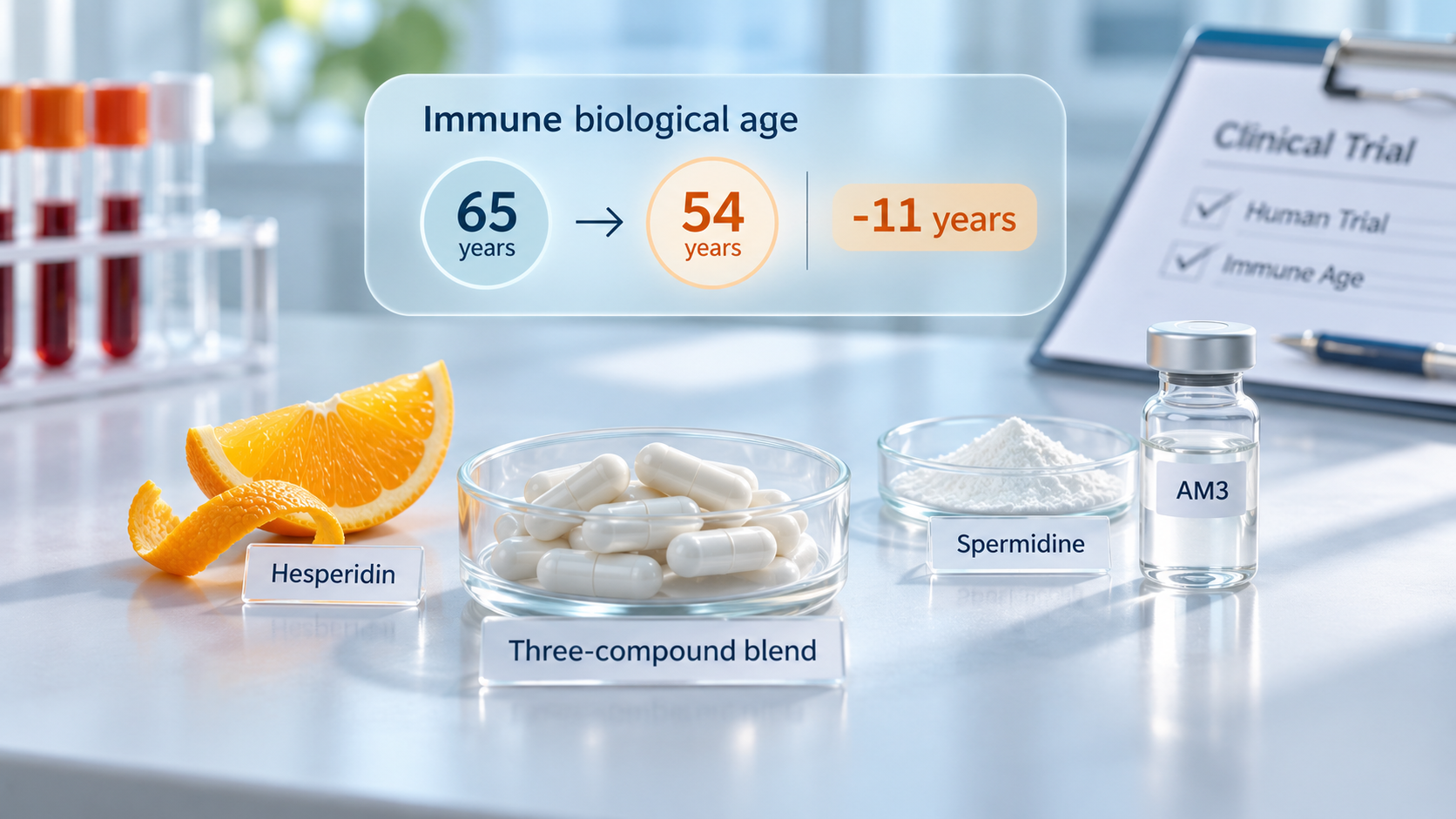
Julia Félix and colleagues at Complutense University of Madrid ran a randomized controlled trial in 41 adults aged 30 to 63. Half took two capsules daily containing AM3 at 150 mg, spermidine at 0.6 mg and hesperidin at 50 mg. The other half took capsules of calcium phosphate and talc. Two months.
Blood was taken before and after. The team measured immune cell function in leukocytes, redox status in whole blood, red cells and plasma, and cytokine levels both in plasma and in cultured mononuclear cells. Then they applied their Immunity Clock, a model that estimates biological age from how well immune cells actually perform rather than from a methylation pattern.
The result: the supplemented group improved on the immune functions the clock is built from, their oxidative and inflammatory state improved, and their estimated biological age fell by 11 years (Félix et al., 2024).
What to do with that: the transferable lesson is about measurement, not about buying this exact blend. If you take supplements for aging and you want to know whether anything is happening, a functional immune readout is a far more informative thing to track than another biological age score from a cheek swab, because it measures what cells do rather than what their DNA looks like. Ask a clinician about a lymphocyte subset panel with function markers alongside the usual inflammatory markers, run it before you start something, and run it again at eight to twelve weeks. Of the three compounds here, hesperidin is the one already abundant in an ordinary diet, in citrus peel and pith, and the one you can raise without buying anything.
What the three compounds are
AM3, also known as Inmunoferón, is the unusual one and carries most of the dose. It is a glycophosphopeptical, a complex of plant polysaccharide and protein, and it has a clinical history in immunology going back decades. A 2001 study in American Journal of Respiratory and Critical Care Medicine found it restored defective natural killer and phagocytic activity in patients with COPD (PMID 11401877), and it has since been examined as a vaccine adjuvant. It is not a longevity compound by reputation. It is an immunomodulator that was brought into a longevity question.
Spermidine is a polyamine, well known in this field for inducing autophagy and for the epidemiology linking higher dietary intake to lower mortality. The dose here deserves attention: 0.6 mg. Typical dietary intake runs into the low tens of milligrams, and spermidine supplements are usually sold at a few milligrams. Whatever this blend did, a large spermidine dose is not the explanation.
Hesperidin is a citrus flavonoid, the compound that makes orange and lemon pith what it is, with a long literature in vascular function and inflammation. Fifty milligrams is a modest amount, reachable from food.
So two of the three are present at doses a determined eater could approach, and the heavy component is an immunomodulator rather than a geroprotector. That shapes how the result should be read.
Why the choice of clock matters
Most biological age estimates in circulation are epigenetic. They read methylation at a set of sites and return a number. They are useful, they are reproducible, and they measure a correlate of aging rather than a function of the organism.
The Immunity Clock used here takes a different route. It is built from how immune cells behave in assay: chemotaxis, phagocytosis, natural killer activity, lymphoproliferation. Those are capabilities, not marks. An improvement in them means cells are doing more of the thing they exist to do.
The model is not invented for this paper. The same group has published it previously and tested the related immunity and redox clocks against lifespan in mice, finding they track it (Sci Rep, 2024). That matters: a clock validated against actual survival in an animal is on firmer ground than one validated only against chronological age.
It is still this group’s own clock, and a result measured on an instrument the authors built is weaker than the same result on an instrument someone else built. We would like to see this replicated by a lab with no stake in the model.
Eleven years is a large number
It should be read as eleven years on this clock, in this population, over this period, not as eleven years of life.
Functional immune measures can move quickly, which is part of why this clock is responsive and part of why a two-month change of that size is less implausible than it first sounds. Immune function is not a slowly accumulating structural property like arterial stiffness. It reflects current state, and current state can shift.
The flip side is that a measure which moves fast in one direction can move fast in the other. Nothing here establishes durability. A follow-up measurement at six or twelve months would tell us whether anything was retained, and that measurement was not made.
Why this trial interests us
Almost every rigorous supplement trial isolates one compound, because that is the design that permits a clean causal claim. The cost is that it can never answer the question people are actually living, which is what several compounds do together.
This trial accepted the ambiguity. It cannot tell us whether AM3 did the work, or hesperidin, or the three in concert, and the authors do not pretend otherwise. What it can tell us is that a defined three-compound blend, at doses that are unremarkable, produced a measurable functional change against a placebo in a randomized design.
That is the shape of evidence our multi-target argument has been asking for. It is one study and a small one, and it points the right way.
There is also a specific hint worth noticing. The spermidine dose is roughly a twentieth of what a spermidine supplement would provide. If spermidine contributed anything, it did so at a dose nobody would bother selling on its own. Combinations can change what a dose means, and that is a serious formulation question rather than a marketing line.
Where this leads
What this study needs is an arm structure: AM3 alone, the blend, placebo. That would separate the immunomodulator from the combination and settle whether the whole did more than the largest part. It is an affordable study and somebody should run it.
It should also be repeated in older participants. The average age here was well under the range where immune decline is steepest, and an intervention aimed at aging should be tested where aging is doing the most damage.
Our research database holds our work on the individual compounds, and the multi-target guide sets out the broader case.
Limitations
Forty-one participants over two months is small and short, the biological age measure is the authors’ own model rather than an independent standard, the design cannot attribute the effect to any one of the three compounds, and no follow-up measurement tested whether the change persisted.
Citations
[1] Félix J, Díaz-Del Cerro E, Baca A, López-Ballesteros A, Gómez-Sánchez MJ, De la Fuente M. Human supplementation with AM3, spermidine, and hesperidin enhances immune function, decreases biological age, and improves oxidative-inflammatory state: a randomized controlled trial. Antioxidants (Basel). 2024;13(11):1391. doi:10.3390/antiox13111391. PMID 39594533
[2] The immunity and redox clocks in mice, markers of lifespan. Sci Rep. 2024. PMID 38242936
[3] Defective natural killer and phagocytic activities in chronic obstructive pulmonary disease are restored by glycophosphopeptical (inmunoferón). Am J Respir Crit Care Med. 2001. PMID 11401877
These statements have not been evaluated by the Food and Drug Administration. MDS Labs does not sell AM3 or the blend described here. Nothing here is intended to diagnose, treat, cure or prevent any disease.
Categories:
Longevity in the News