
Nov
06
Disease Is Multifactorial. The Evidence Says Support Should Be Too.
0 Comments
Drug discovery has spent decades refining one molecule against one target. Pharmacology’s own literature has questioned that approach since 2008, and the evidence from pain research, dementia trials and aging biology supports the doubt.
The short version
Food sustains life through hundreds of compounds acting on many systems at once. No single molecule in a meal does the work on its own.
Medicine developed along a different line. The goal for decades has been one molecule acting on one target with as much precision as possible, and for many problems that approach succeeds. Antibiotics, statins and anticoagulants each have a single clear job.
Conditions associated with aging are harder. Alzheimer’s disease involves amyloid, tau, inflammation, vascular insufficiency and mitochondrial decline together. Chronic pain involves signalling, inflammation and glial activation together. Aging itself is described in current biology as twelve interlocking processes. Networks of that kind absorb pressure applied at any one point, which is the standard explanation for why drugs in these areas tend to produce small and temporary effects.
The argument appeared in Nature Chemical Biology in 2008, from the pharmacologist who went on to name the field of network pharmacology. Where multi-compound approaches have since been tested carefully they have held up. Herbal formulas matched donepezil on the cognitive scale used in Alzheimer’s registration trials. Combination treatment helps between 30 and 50 percent of chronic pain patients. One traditional formula improved frailty, grip strength and walking speed against placebo in 530 people, and a single constituent of another extended mouse lifespan by 17 percent.
What to do with that: judge a supplement by whether its ingredients address different parts of one problem, and whether each appears at an amount the published work used. A blend assembled on that basis has a rationale behind every ingredient. Most products on the shelf cannot show one.
Where single-target thinking came from
The one-drug-one-target model produced antibiotics, antivirals, statins and much of modern medicine. It also made drugs tractable to study, since a single mechanism supports a clean hypothesis and a trial designed around it.
Andrew Hopkins set out its limits in Nature Chemical Biology in 2008. The dominant paradigm, he wrote, is the design of maximally selective ligands against individual targets, yet many effective drugs act by modulating several proteins at once. Systems biology had by then revealed a phenotypic robustness in biological networks suggesting that exquisitely selective compounds may show lower clinical efficacy than multi-target ones (Hopkins, 2008).
Phenotypic robustness describes the capacity of a living system to keep functioning when one component fails. It explains how a highly selective drug can engage its target completely and still change very little about how a patient feels.
Pain is the clearest worked example
Chronic pain is where the multi-target case has been developed most concretely. A 2022 review in Frontiers in Pharmacology examined the analgesic alkaloids of traditional Chinese medicine and described them along two axes, together termed the drug cloud, or dCloud (Jiang et al., 2022).
Direct efficacy covers what is usually meant by a painkiller: blocking an ion channel, activating an opioid or GABA receptor, suppressing the signal. Background efficacy covers the conditions that sustain the pain, among them neuronal inflammation, oxidative stress, glial activation, and a lost balance between excitatory and inhibitory signalling.
Treatment confined to direct efficacy quiets the signal while leaving those conditions in place, which describes a good deal of what long-term analgesic use looks like. The authors report that drug combination benefits 30 to 50 percent of chronic pain patients, and build their framework around covering both axes at once.
They took the structure from classical formula design. Chinese formulas assign each herb a role: Jun, Chen, Zuo and Shi, conventionally rendered as sovereign, minister, assistant and envoy. The sovereign addresses the main complaint, the minister supports it, the assistant moderates side effects, and the envoy directs the others to their site of action. That architecture maps onto direct and background efficacy, and it predates any knowledge of receptors by centuries.
What the dementia trials showed
Alzheimer’s disease offers a demanding test, since single-target drugs have been studied there more thoroughly than almost anywhere else and have underdelivered.
A systematic review pooled 57 randomized controlled trials of herbal medicine in Alzheimer’s disease. Against conventional treatment, herbal medicine improved both the Mini-Mental State Examination and the ADAS-cog. In trials comparing herbal medicine head to head against donepezil, the most widely prescribed drug for the condition, MMSE scores were equivalent and ADAS-cog favoured the herbal arm. Added to conventional treatment, herbal medicine improved both scales beyond conventional treatment alone (Lee et al., 2022).
A second, independent review of 23 trials and roughly 2,000 patients found the same direction on the same instrument, a standardized mean difference of −0.22 on ADAS-cog favouring herbal treatment. Adverse events did not differ between arms, with zero heterogeneity on that outcome (Wang et al., 2025).
ADAS-cog is the more sensitive of the two instruments and the one generally chosen as the primary endpoint in Alzheimer’s registration trials. A result replicated in two independent pools, on that instrument, against an active drug, carries more weight than the usual placebo comparison. Behavioural symptoms and daily function showed no benefit. Cognitive and behavioural domains dissociate routinely in trials of approved drugs, so the pattern is unremarkable.
Which formulas were tested
Reviews of this kind often leave a reader without knowing what was actually given. Here the record is specific.
Three formulas appeared more than once in add-on use across the 57 trials: Bushenyizhi Granule in three studies, Yizhi Jiannao Granule in four, and Bushenyisui Formula in three. Yokukansan, Ginkgo biloba and Korean ginseng each appeared twice. Of all of them, Bushenyizhi Granule produced the largest significant gain on MMSE when added to conventional treatment, a mean difference of 3.58 (Lee et al., 2022).
Counted by individual herb, Acori Graminei Rhizoma appeared in 30 studies, Cnidii Rhizoma in 25 and Ginseng Radix in 17. Formulas containing Acorus or Cnidium significantly improved both MMSE and ADAS-cog against conventional treatment, while ginseng-containing formulas did not reach significance. The authors are explicit that these herbs were almost always given inside multi-herb formulas, so an individual contribution cannot be separated out.
What Bushen-Yizhi actually is
Bushen-Yizhi is a prescription developed at Guangzhou University of Chinese Medicine and used for kidney deficiency and cognitive decline. It contains six herbs in a 3:3:2:2:2:2 ratio (Hou et al., 2014):
- She Chuang Zi, Cnidium monnieri, fruit. The source of osthole.
- Ren Shen, Panax ginseng, rhizome.
- Zhi He Shou Wu, Polygonum multiflorum, prepared root.
- Mu Dan Pi, Paeonia suffruticosa, root bark.
- Nv Zhen Zi, Ligustrum lucidum, fruit.
- Gou Qi, Lycium barbarum, fruit.
HPLC fingerprinting across ten production batches identified eight marker compounds: paeoniflorin, 2,3,5,4′-tetrahydroxystilbene-2-O-β-D-glucoside, paeonol, ginsenoside Rg1, ginsenoside Rb1, imperatorin, osthole and oleanolic acid, with a batch-to-batch similarity index of 0.986. In the same work, oral dosing improved cognition in scopolamine-treated mice and restored superoxide dismutase and glutathione levels in the hippocampus (Hou et al., 2014).
A later study in SAMP8 mice, a senescence-accelerated strain used as an aging model, reported that the formula raises SIRT1 expression and relieves endoplasmic reticulum stress (Zhang et al., 2017). SIRT1 is among the most studied longevity genes, which places this formula squarely inside aging biology.
One point of care on nomenclature. The meta-analysis counts Cnidii Rhizoma, a rhizome, while Bushen-Yizhi contains Cnidium monnieri fruit. Those are different plant parts and may be different species, so each is reported here as its own source states.
One formula is not the finding
Bushen-Yizhi is the best documented example, and it would be a poor argument if it were the only one. The wider literature contains many multi-herb preparations with aging-relevant evidence behind them, and they reach different parts of the problem.
A randomized trial on aging itself
Bazi Bushen Capsule was tested in a parallel, multicentre, double-blind, randomized, placebo-controlled trial. 530 subjects aged 30 to 78 received the capsule or placebo for 12 weeks. Frailty scores and a kidney-deficiency aging scale both improved more than placebo, quality of life on SF-36 rose by 98.38 against 23.79 on placebo, and in the elderly subgroup grip strength, balance, walking speed, sit-to-stand time and muscle mass all improved. Telomerase content rose by 150.04 ng/ml against placebo (Mei et al., 2024). The trial, the epigenetic clock study behind it and the sourcing problem its recipe creates are covered in full in our article on Bazi Bushen.
The authors also report what did not happen: telomere length itself did not significantly increase. Three adverse events, 1.14 percent, were judged related to the capsule. A trial that reports its null result alongside its positive ones is worth more than one that does not, and the functional measures here are the ones that describe how well a person actually lives.
Lifespan extension from a single constituent
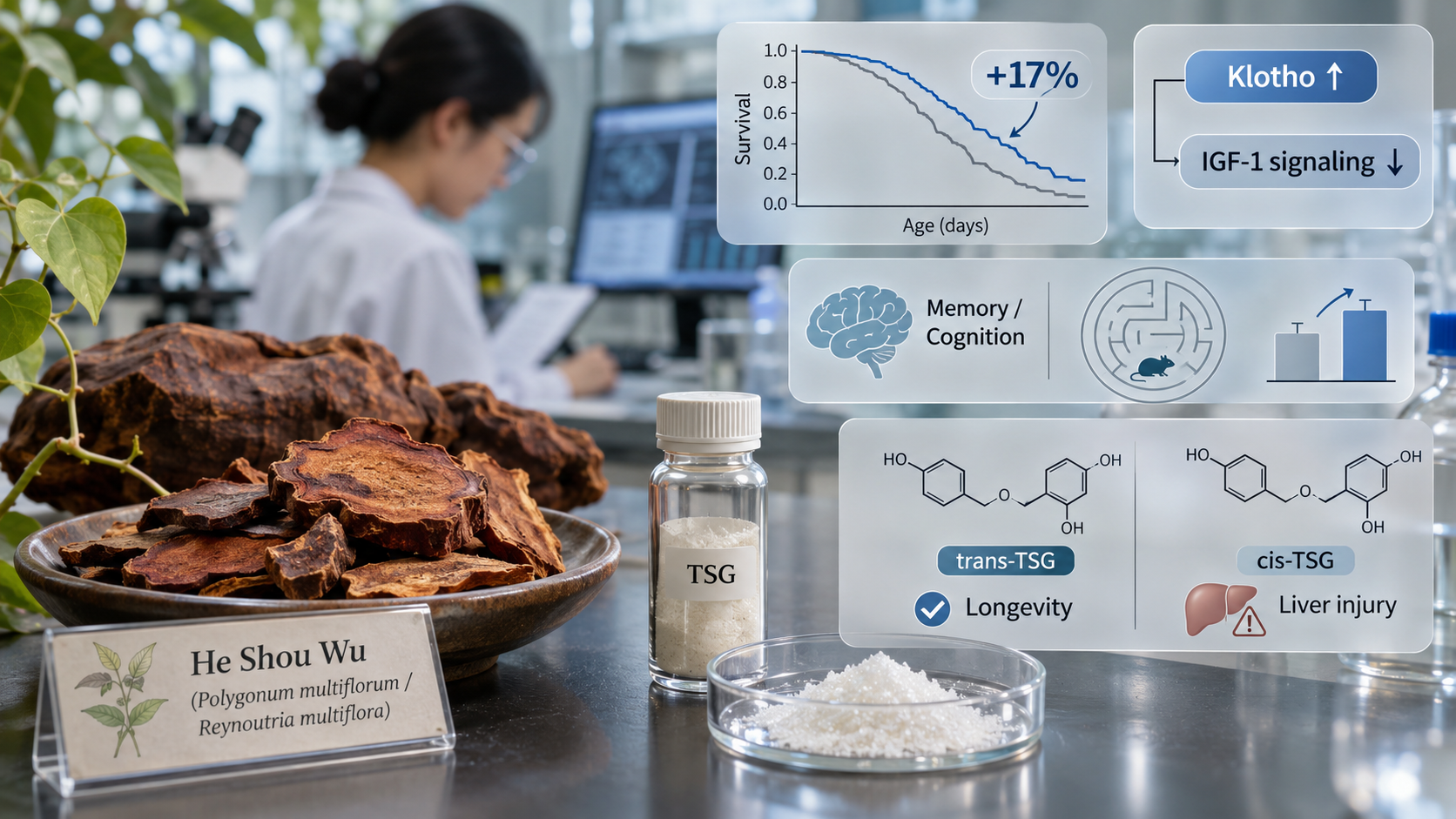
Tetrahydroxystilbene glucoside, or TSG, comes from Polygonum multiflorum. Given to senescence-accelerated SAMP8 mice it improved memory and extended lifespan by up to 17 percent, acting by raising neural klotho and lowering neural insulin and IGF-1 signalling (Zhou et al., 2015).
Klotho and insulin/IGF-1 signalling are two of the most studied longevity pathways in any organism. TSG is also one of the eight marker compounds identified by HPLC in Bushen-Yizhi, and Polygonum multiflorum is one of its six herbs, so the two files connect.
Senescence and stem cell reserve
Rehmannia glutinosa was fed to mice for ten months against a standard diet. Hematopoietic stem cells in the treated animals showed less senescence and better maintained quiescence, assessed by cell sorting and clonogenic assay, with survival analysis and a graded phenotype score alongside (Bai et al., 2018). Stem cell exhaustion is one of the hallmarks, and ten months of dietary administration is a serious exposure.
Autophagy
Dendrobine, isolated from Dendrobium nobile by lifespan-guided fractionation, extended both replicative and chronological lifespan in yeast through the Sch9/Rim15/Msn2 pathway, with effects on oxidative stress and autophagy confirmed in knockout strains (Wu et al., 2023). This is yeast work, which places it earlier than the others, though the pathway it identifies is conserved and the isolation method was driven by lifespan rather than by assay convenience.
What the spread shows
Taken together these reach a human frailty trial, a mammalian lifespan result, a stem cell senescence result and an autophagy mechanism, through four unrelated preparations. The dementia formulas add more: Bushenyisui Formula combines Epimedii Herba, Ligustri Lucidi Fructus, Psoraleae Semen, Radix Polygoni Multiflori, Astragali Radix, Cnidii Rhizoma and Acori Graminei Rhizoma, and improved MMSE with low heterogeneity in the pooled analysis.
No single one of these results would carry much weight. The pattern across them is the argument, and it is the same pattern the pain and dementia literature shows: preparations assembled from several plants, acting at several points, producing effects where single agents have struggled.
The evidence, article by article
Each compound and formula summarised above is covered in full in its own article, with the primary studies, the mechanisms and what is actionable about each.
- Bazi Bushen: a randomized human trial on aging
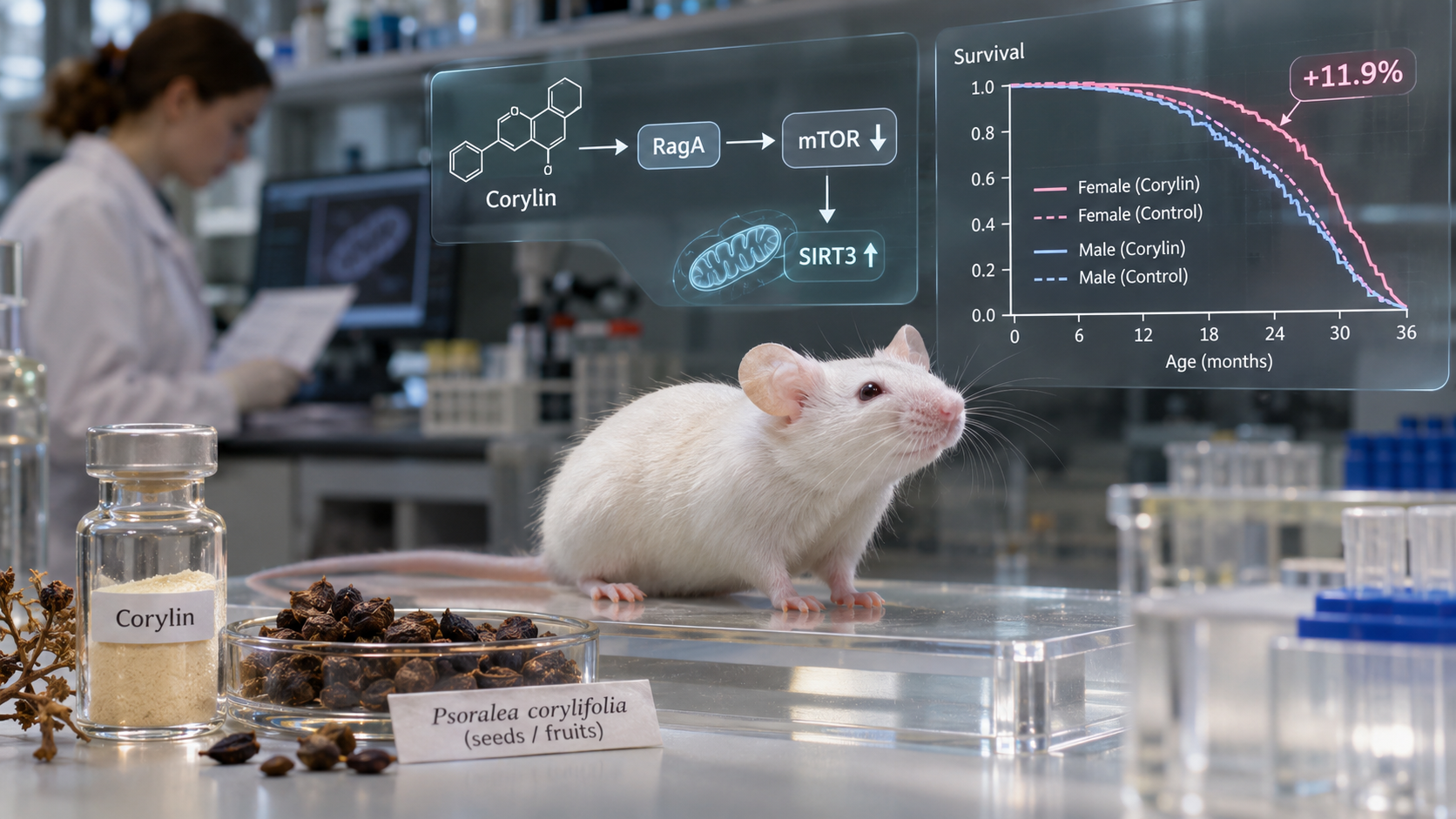
- Corylin: mid-life dosing extended female mouse lifespan
- TSG and He Shou Wu: lifespan, klotho and the isomer problem
- Vascular aging: five compounds, one cascade
- Three routes to autophagy
- Reishi and Rehmannia: stem cell reserve
- Panax notoginseng: the other ginseng
- Direct and background efficacy: the dCloud pain framework
Aging is multifactorial by definition
Current biology describes aging as twelve interconnected hallmarks, among them deregulated nutrient sensing, loss of proteostasis, cellular senescence and chronic inflammation (López-Otín et al., 2023). The hallmarks drive one another, so an intervention at a single point tends to deliver less than its mechanism suggests.
Pharmaceutical work in the area has arrived at combinations for the same reason. The best known senolytic protocol pairs dasatinib with quercetin, because the survival pathways keeping senescent cells alive vary between cell types and no single agent covers them all (Chaib, Tchkonia and Kirkland, 2022). The reasoning behind a two-drug protocol and the reasoning behind a multi-herb formula are the same reasoning, reached from opposite directions.
The part traditional formulas got right
Multi-compound preparations can do something a single compound cannot, and the clearest demonstration of it is pharmacokinetic.
Researchers screened the constituents of Bushen-Yizhi for inhibition of CYP3A4, the enzyme that clears many compounds from the body. Twenty-one candidates were identified computationally and four confirmed in vitro: oleic acid, 1,2,3,4,6-O-pentagalloylglucose, rutin and schisantherin B. Schisantherin B was the most potent, with an IC50 of 0.339 µM, stronger than ketoconazole, the clinically used inhibitor taken as the comparator.
In rats, the whole formula raised exposure to osthole, its principal active, from 228 to 2,196 ng/L·h, approximately tenfold. The isolated lignan reached 1,053, and ketoconazole reached 463 (Liu et al., 2022).
The complete formula delivered more of its own active compound into circulation than either the isolated constituent or a pharmaceutical inhibitor achieved. The envoy role, in other words, is measurable. A tradition with no concept of hepatic metabolism had reserved a functional position for delivery.
Some constituents engage targets and others govern how much of the first group arrives, which is the practical reason a well-constructed blend behaves differently from its ingredient list.
What this means for a supplement
Network pharmacology is now an established method for this question, developed to map how multi-component, multi-target, multi-pathway preparations act on complex disease (Li et al., 2023). Applied carefully it supplies what many blends lack, which is a reason for every ingredient.
Three questions establish whether a formula has one. Which part of the problem does each ingredient address, and do those parts differ? Is each present at an amount the published work used? Is anything included to improve how much of the rest reaches circulation?
Most products fail at least one of the three, usually because the combination was assembled without a question in mind.
These formulas are useful to us for a practical reason. The herbs are named, the ratio is published, the marker compounds are identified by HPLC, and the compounds responsible for getting the active into circulation have been tested one by one. That is enough information to supply the same compounds at measured amounts, which is the work MDS Research does. Rutin, one of the four confirmed bioavailability enhancers in Bushen-Yizhi, is already on our shelf as a standardized powder. The compounds named above are the starting list for what comes next, and the work is to establish which of them survive scrutiny, at what exposure, and in what combination.
Where the evidence is thin
The dementia trials are methodologically weak and consistently so. In the 2025 analysis, 15 of 23 scored 3 or below on a 7-point quality scale, only two used a placebo, and every participant was recruited in China. Those weaknesses constrain the size of the effect more than its direction, and they do not account for a result replicated across two independent pools against an active comparator. They are also fixable by better trial conduct. A single standardized formula with quantified marker compounds, tested blind against placebo in more than one country, would settle the question.
Citations
[1] Hopkins AL. Network pharmacology: the next paradigm in drug discovery. Nat Chem Biol. 2008;4(11):682-90. PMID 18936753
[2] Jiang W, Tang M, Yang L, et al. Analgesic alkaloids derived from traditional Chinese medicine in pain management. Front Pharmacol. 2022;13:851508. PMID 35620295
[3] Lee J, Kwon S, Jin C, et al. Traditional East Asian herbal medicine treatment for Alzheimer’s disease: a systematic review and meta-analysis. Pharmaceuticals. 2022;15(2):174.
[4] Wang Q, Wang D-L, Zhang X-C, et al. Efficacy and safety of traditional Chinese medicine and Western medicine in Alzheimer’s disease: a systematic review and meta-analysis. Front Neurol. 2025;16:1607945.
[5] López-Otín C, Blasco MA, Partridge L, Serrano M, Kroemer G. Hallmarks of aging: an expanding universe. Cell. 2023;186(2):243-278. PMID 36599349
[6] Chaib S, Tchkonia T, Kirkland JL. Cellular senescence and senolytics: the path to the clinic. Nat Med. 2022;28(8):1556-1568. PMID 35953721
[7] Liu JM, Chen JM, Lin MJ, et al. Screening and verification of CYP3A4 inhibitors from Bushen-Yizhi formula to enhance the bioavailability of osthole. 2022.
[8] Li X, Liu Z, Liao J, et al. Network pharmacology approaches for research of traditional Chinese medicines. Chin J Nat Med. 2023;21(5):323-332. PMID 37245871
[9] Hou XQ, Wu DW, Zhang CX, et al. Bushen-Yizhi formula ameliorates cognition deficits and attenuates oxidative stress-related neuronal apoptosis in scopolamine-induced senescence in mice. Int J Mol Med. 2014;34(2):429-39. PMID 24919922
[10] Zhang SJ, Xu TT, Li L, et al. Bushen-Yizhi formula ameliorates cognitive dysfunction through SIRT1/ER stress pathway in SAMP8 mice. Oncotarget. 2017;8(30):49338-49350. PMID 28521305
[11] Mei J, Ju C, Wang B, et al. The efficacy and safety of Bazi Bushen Capsule in treating premature aging: a randomized, double blind, multicenter, placebo-controlled clinical trial. Phytomedicine. 2024;130:155742. PMID 38838635
[12] Zhou X, Yang Q, Xie Y, et al. Tetrahydroxystilbene glucoside extends mouse life span via upregulating neural klotho and downregulating neural insulin or insulin-like growth factor 1. Neurobiol Aging. 2015;36(3):1462-70. PMID 25595496
[13] Bai L, Shi GY, Yang YJ, et al. Rehmannia glutinosa exhibits anti-aging effect through maintaining the quiescence and decreasing the senescence of hematopoietic stem cells. Animal Model Exp Med. 2018;1(3):194-202. PMID 30891565
[14] Wu E, Lian Y, Zhao S, et al. Involvement of the Sch9/Rim15/Msn2 signaling pathway in the anti-aging activity of dendrobine from Dendrobium nobile Lindl. Chin Med. 2023;18(1):111. PMID 37670345
These statements have not been evaluated by the Food and Drug Administration. Nothing here is intended to diagnose, treat, cure or prevent any disease. Consult a healthcare professional before use, particularly if you take prescription medication.
Categories:
MDS Research Articles