
Nov
08
Five Compounds, One Cascade: Botanical Research on Vascular Aging
0 Comments
Blood vessels age in a sequence, and each step has been studied separately. Six botanical compounds turn up across that sequence, and almost none of them act at the same point.
The short version
Your arteries have a lining one cell thick. That lining does a job most people never think about: it releases a gas called nitric oxide, which tells the muscle in the vessel wall to relax. Relaxed vessels are wide vessels, and wide vessels mean lower pressure and better flow.
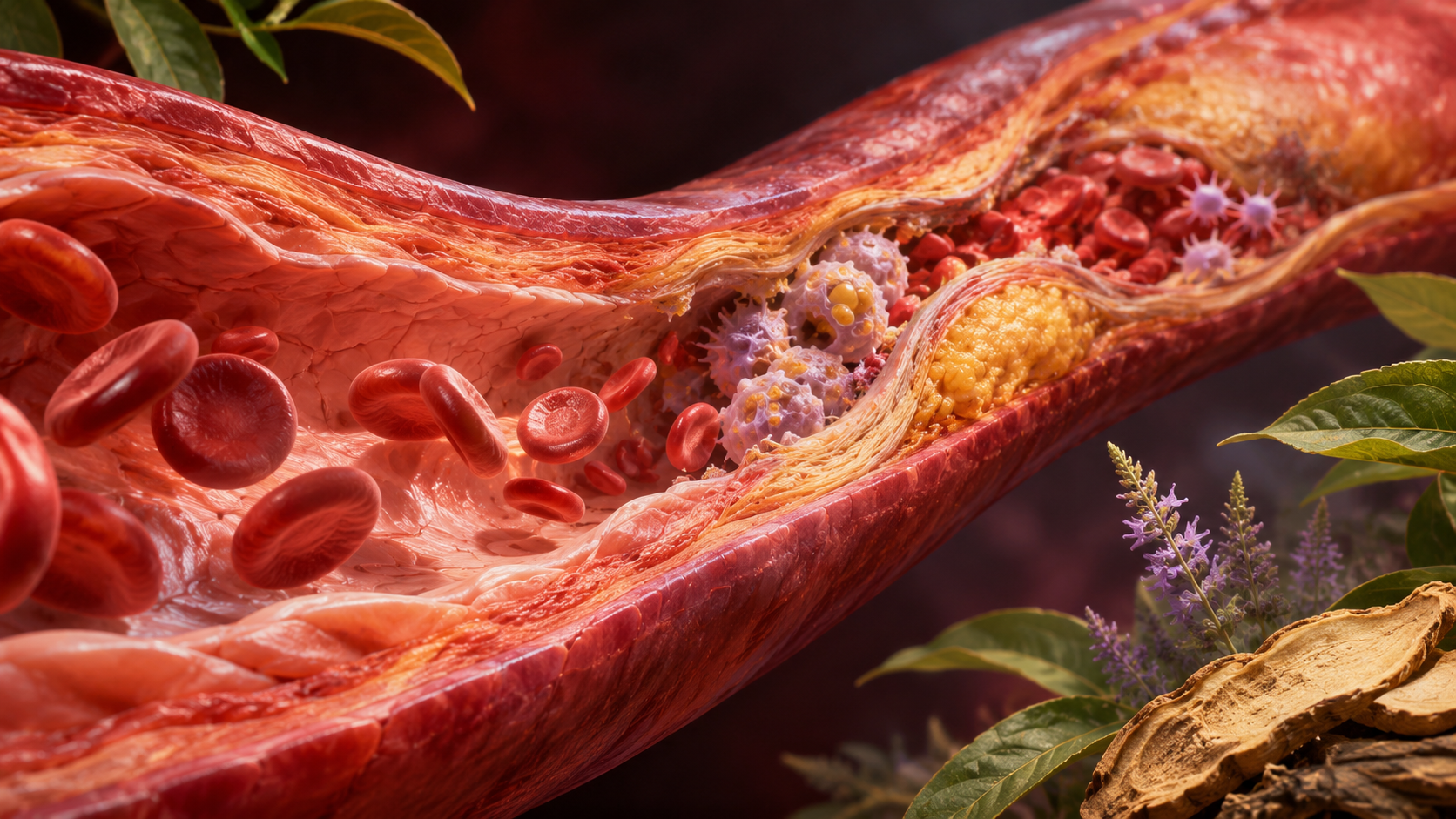
Vascular aging is what happens when that stops working properly. The lining makes less nitric oxide. The vessel walls stiffen. Cholesterol works its way into the wall, immune cells come to clean it up and get stuck there, and the whole thing becomes slower, harder and more prone to clotting.
It happens in a sequence, and the sequence is well mapped. What is interesting is that botanical research has landed on almost every step of it, usually one compound per step:
- The lining stops making nitric oxide properly, and astragaloside IV from astragalus acts there
- Lining cells die off under inflammatory stress, and oxymatrine from Ku Shen acts there
- Immune cells gorge on oxidized cholesterol and turn into foam, and clematichinenoside AR acts there
- Plaque builds and the artery stiffens, and dehydrocorydaline from Corydalis acts there
- Platelets become quick to activate and clot, and tanshinone IIA from danshen acts there
- And a whole Schisandra extract was tested against the finished result in animals, alongside a statin
What to do with that: no single one of these is a treatment, and none has a human trial for vascular aging. The useful takeaway is how to read a cardiovascular blend. If every ingredient in a formula is an antioxidant, it is covering one step six times. A formula built from this literature would instead pick up different points in the sequence, and you can check that from an ingredient list once you know the sequence exists.
What vascular aging actually is
Vascular aging is defined by structural and functional change in the blood vessels, with arterial stiffness and endothelial dysfunction as its two key components, and it raises the risk of cardiovascular and other age-related disease. The molecular pathways identified as central include oxidative stress and inflammation (Roth et al., 2023).
Two things follow from that definition. The first is that vascular aging is a process rather than an event, so there are several places to intervene. The second is that it is measurable in a living person through arterial stiffness, which is why it is one of the more tractable parts of aging biology.
Step one: the lining stops making nitric oxide
The enzyme that produces nitric oxide in the vessel lining is called eNOS. Under oxidative stress it does something unfortunate called uncoupling, where the enzyme keeps running but produces reactive oxygen species instead of nitric oxide. The machine that made the useful thing starts making the damaging thing, and it does so at the expense of the useful thing.
Astragaloside IV is the main active compound of astragalus. The review literature reports that it can prevent or reverse eNOS uncoupling, raise both eNOS and nitric oxide, reduce endothelial cell apoptosis under oxidative stress, and activate several enzymes of the antioxidant system (Meng et al., 2021).
Step two: the lining cells die under inflammatory stress
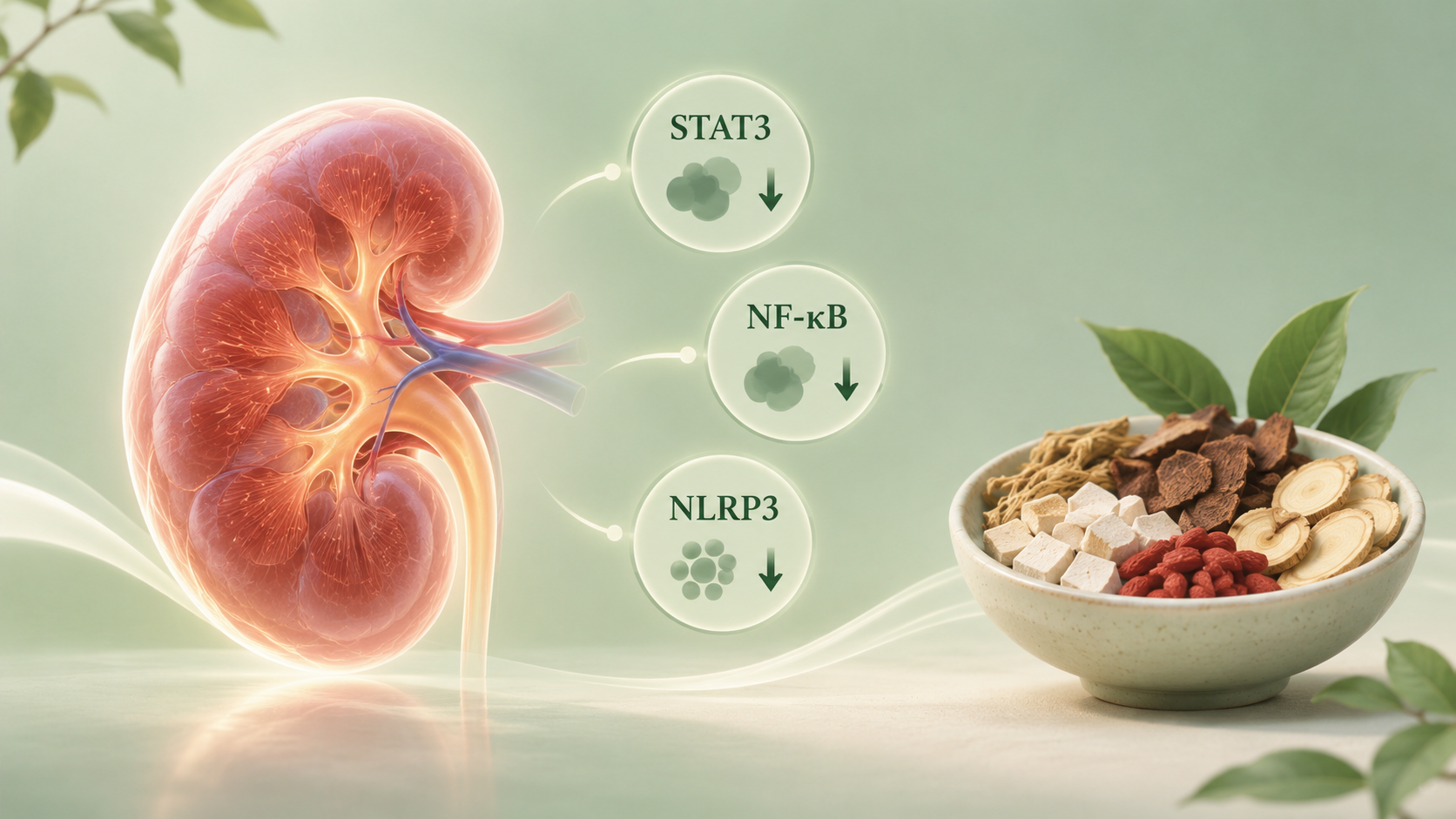
Oxidized LDL damages the lining, and one way lining cells die is pyroptosis, an inflammatory form of cell death driven by a protein assembly called the NLRP3 inflammasome. Cells dying this way burst and spill inflammatory signals, so the damage spreads outward.
Oxymatrine, the alkaloid from Ku Shen, was tested on human umbilical vein endothelial cells injured by oxidized LDL. It suppressed NLRP3 inflammasome-mediated pyroptosis by activating SIRT1 and Nrf2, with antioxidant enzyme activity recovering alongside (Jin et al., 2021).
SIRT1 is a longevity gene and Nrf2 governs the inducible antioxidant response, so this is a compound reaching a vascular problem through general aging machinery. Our article on Ku Shen covers the rest of its file.
Step three: immune cells turn into foam
When oxidized cholesterol accumulates in the vessel wall, macrophages arrive to clear it. They take in more than they can process, fill with lipid droplets, and become what pathologists call foam cells, which then lodge in the wall as the beginnings of plaque.
Clematichinenoside AR, from Clematis chinensis, was tested in macrophages exposed to oxidized LDL. It reduced foam cell formation, measured directly by Oil Red staining, lowered cholesterol levels in the cells, and reduced inflammatory cytokine expression (Diao et al., 2021).
Step four: plaque builds and the artery stiffens
This step is where vascular aging becomes measurable. Aortic compliance describes how much the main artery gives when blood is pushed into it, and losing that springiness is the stiffening half of the standard definition.
Dehydrocorydaline, an alkaloid from Corydalis yanhusuo, was given to ApoE-deficient mice, a strain that develops atherosclerosis reliably. It inhibited plaque development, improved aortic compliance, increased plaque stability, and reduced systemic and vascular inflammation (Wen et al., 2022).
Improving compliance is the result worth noting. Plaque burden and arterial stiffness are related but separate, and stiffness is the one that maps directly onto the vascular aging definition.
Step five: platelets become quick to clot
The last step is the one that turns a slow problem into a sudden one. Aged, inflamed vessels make platelets easier to activate.
Tanshinone IIA, from danshen, was studied against a specific trigger. Platelets exposed to the inflammatory signal IL-6 shed small fragments called microvesicles, and those fragments activate other platelets through CD36 and the MKK4/JNK2 signalling route. Tanshinone IIA prevented platelet activation and downregulated that pathway (Wang et al., 2020).
IL-6 rises with age as part of chronic low-grade inflammation, so this links inflammaging to clotting risk through a defined route.
The whole-animal test
The five above are mechanisms. One study took a whole extract and measured the finished outcome.
An ethanol extract of Schisandra chinensis fruit was given to rats with experimentally induced atherosclerosis for three weeks, with simvastatin as the active comparator, and the extract was quantified by HPLC for schisandrin, schisandrin A and schisandrin B so the dose is defined (Chen et al., 2018). Running against a statin rather than against nothing is the harder test, and quantifying the markers means the preparation could be reproduced.
What the pattern shows
Six compounds from six unrelated plants, landing on five consecutive steps of one cascade, is the clearest worked example of the argument in our piece on multi-target formulations. Nobody designed this spread. It emerged because different research groups chased different parts of the same problem.
It also shows what a thoughtful formula would have to look like. Most cardiovascular supplement blends stack antioxidants, which addresses one step repeatedly. The literature here suggests a different shape: something for the lining, something for the inflammatory cell death, something for lipid handling in macrophages, something for stiffness, something for platelets. Whether such a combination would work is untested. The point is that the sequence gives you a way to ask the question.
Limitations
Every result above is from cells or animals, none of these compounds has a human trial for vascular aging or arterial stiffness, and the astragaloside IV evidence is a review of preclinical work rather than a single experiment; a compound active at a given concentration in a dish has not been shown to reach that concentration in a person after oral dosing.
Citations
[1] Roth et al. Pharmacological modulation of vascular ageing: a review from VascAgeNet. Ageing Res Rev. 2023. PMID 37956927
[2] Meng et al. Molecular mechanism of astragaloside IV in improving endothelial dysfunction of cardiovascular diseases mediated by oxidative stress. Oxid Med Cell Longev. 2021. PMID 34840664
[3] Jin X, Fu W, Zhou J, et al. Oxymatrine attenuates oxidized low-density lipoprotein-induced HUVEC injury by inhibiting NLRP3 inflammasome-mediated pyroptosis via activation of the SIRT1/Nrf2 signaling pathway. Int J Mol Med. 2021;48(4):187. PMID 34368883
[4] Diao et al. Clematichinenoside AR alleviates foam cell formation and the inflammatory response in ox-LDL-induced RAW264.7 cells. Inflammation. 2021. PMID 33151398
[5] Wen et al. Antiatherosclerotic effect of dehydrocorydaline on ApoE-/- mice: inhibition of macrophage inflammation. Acta Pharmacol Sin. 2022. PMID 34552216
[6] Wang et al. Tanshinone IIA prevents platelet activation and down-regulates CD36 and MKK4/JNK2 signaling pathway. BMC Cardiovasc Disord. 2020. PMID 32059638
[7] Chen et al. Ethanol extract of Schisandrae chinensis fructus ameliorates the extent of experimentally induced atherosclerosis in rats. Pharm Biol. 2018. PMID 31070526
These statements have not been evaluated by the Food and Drug Administration. The compounds discussed here are research subjects and nothing on this page is a recommendation to use any of them. Nothing here is intended to diagnose, treat, cure or prevent any disease.
Categories:
MDS Research Articles