
Nov
08
Reishi and Rehmannia: Two Tonic Herbs Tested Against Stem Cell Aging
0 Comments
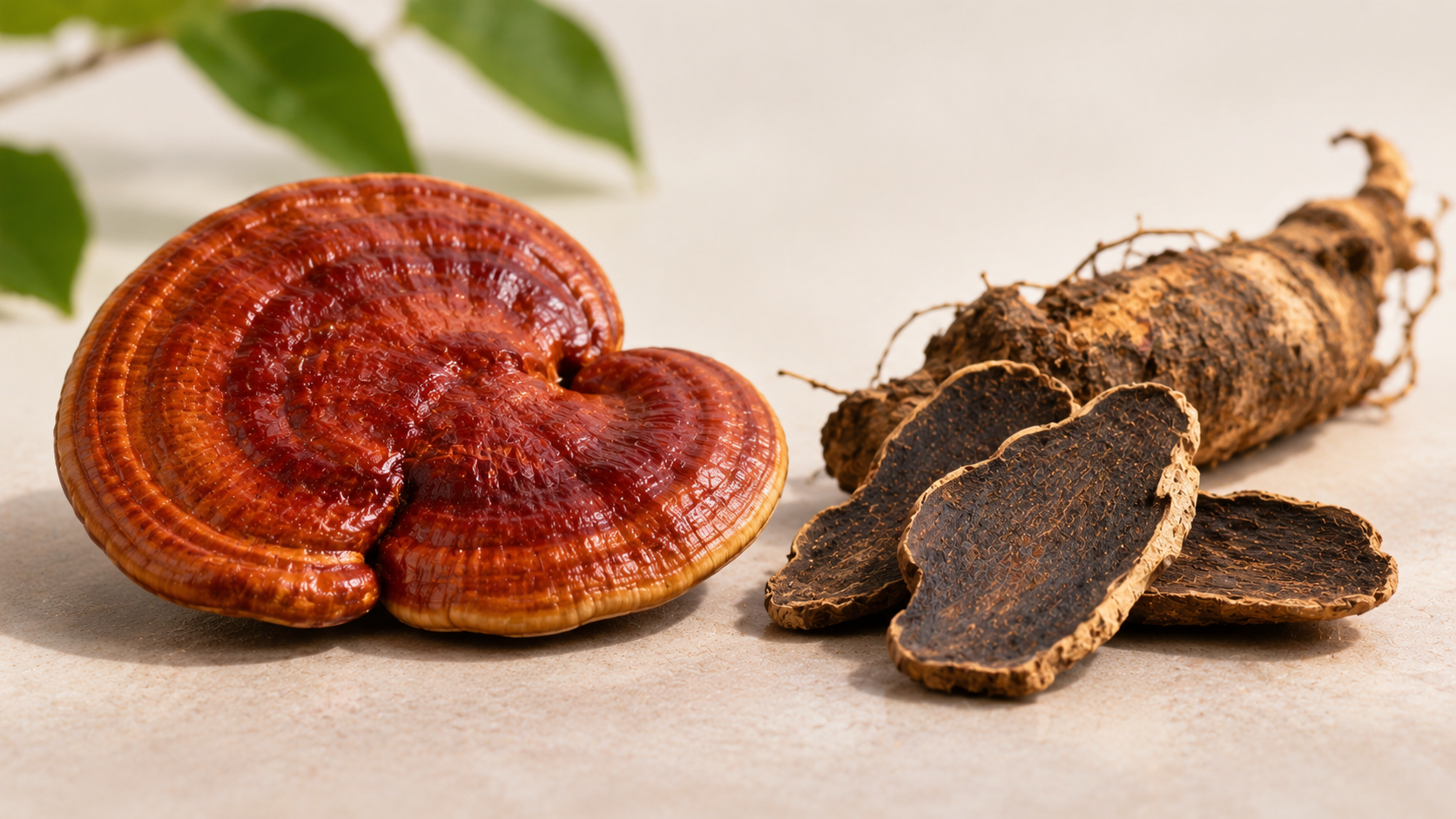
Reishi and Rehmannia have been given as longevity tonics for centuries, which is the kind of claim that usually evaporates on inspection. Both have now been tested against measurable aging endpoints, and both came back with something.
The short version
Your body keeps a reserve of unspecialised cells whose job is to replace worn-out ones. Blood is the clearest case: the cells that make blood sit mostly idle, and divide only when needed. That resting state is called quiescence, and it is protective, because every division carries a risk of damage.
With age the reserve runs down. Fewer stem cells, and the survivors become senescent, meaning they stop dividing but refuse to die. Stem cell exhaustion is one of the named hallmarks of aging, and it is the reason tissue repair slows as people get older.
Rehmannia glutinosa was fed to mice for ten months. Their blood stem cells held their resting state better and showed less senescence than animals on a standard diet.
Ganoderma lucidum, known as reishi, has a long list of extracts and isolated compounds reported to extend lifespan in model organisms. In 2024 researchers screened 74 purified compounds from it and found one, methyl ganoderate E, that extended lifespan in C. elegans and moved several aging-related measures.
What to do with that: both of these are classic tonic herbs, and the research supports the traditional use more specifically than most. Reishi is the better-characterised of the two, with the caveat that the active fraction depends on the extract, so a reishi product should state whether it is standardised to polysaccharides or triterpenes. For Rehmannia, the study used ten months of dietary feeding, which means its result speaks to long-term use rather than a short course.
Why stem cell reserve is the endpoint
Most aging measures are indirect. Oxidative stress markers, inflammatory cytokines and methylation clocks all correlate with aging without describing the thing people actually experience, which is that bodies repair themselves more slowly.
Stem cell exhaustion is closer to that experience. When the reserve declines, wounds heal slower, blood counts recover slower, and tissue that was replaceable becomes less so. It sits among the hallmarks of aging for that reason (López-Otín et al., 2023).
Rehmannia and the blood stem cell reserve
Rehmannia glutinosa, Di Huang, is among the most used herbs in Chinese medicine and appears in a great many formulas aimed at depletion and aging. Researchers tested it directly by feeding mice a diet supplemented with it for ten months, against a standard diet control.
Hematopoietic stem cells in the treated animals showed less senescence and better maintained quiescence, measured by cell sorting, with function assessed by clonogenic assay and the animals followed by survival analysis and a graded phenotype score (Bai et al., 2018).
Two details raise this above the usual. Ten months of dietary administration is a long exposure in a mouse, covering a substantial share of its life, which is a fair test of a herb traditionally taken continuously. And the same study tested Astragalus membranaceus alongside it, the source of astragaloside IV from our vascular aging article, so two classic tonics went into one experiment.
Reishi, and the problem of which reishi
Ganoderma lucidum is a white-rot fungus used as a tonic for promoting health and longevity. The review literature lists a striking number of preparations and components reported to extend lifespan or produce related effects: ethanol extract, aqueous extract, mycelial extract, ganodermasides A through D, several polysaccharide fractions, a peptide, a polysaccharide peptide, total triterpenes and ganoderic acid C1 (Wang et al., 2017).
That list is both the strength and the difficulty. Many preparations show activity, and they are chemically unalike, so the word reishi on a label carries much less information than it appears to. Polysaccharides and triterpenes are different molecules extracted by different solvents, and a hot water extract and an ethanol extract of the same mushroom are not the same product.
More recent work narrowed the question. Researchers screened a library of 74 pure compounds isolated from the fungus, using the cell’s system for handling misfolded proteins as the screen. One compound stood out, methyl ganoderate E, and it extended lifespan in Caenorhabditis elegans while moving several aging-related indicators (Okoro et al., 2024).
Screening 74 compounds and reporting the one that worked is the opposite of the usual approach, where a single compound is tested and a positive result published. It also produces something actionable: a named molecule rather than a mushroom.
What these two have in common
Both are tonics in the traditional sense, meaning they were given continuously to maintain rather than briefly to treat. Both have now been tested in ways that fit that use, with ten months of feeding in one case and lifespan in the other.
Both also illustrate the same practical problem. The traditional material is a whole organism, the active fraction depends on how it is extracted, and the research is moving toward named compounds. Our article on multi-target formulations covers why the whole preparation often does something the isolated compound cannot, and the honest position is that both halves of that are true and the field has not finished sorting out which applies where.
Limitations
The reishi lifespan result is in a nematode and the Rehmannia result is in mice, with no human trial of either for an aging outcome, and the range of reishi preparations reported active makes it difficult to say what an equivalent human product would even be.
Citations
[1] Bai et al. Rehmannia glutinosa exhibits anti-aging effect through maintaining the quiescence and decreasing the senescence of hematopoietic stem cells. Animal Model Exp Med. 2018;1(3):194-202. PMID 30891565
[2] Wang et al. Emerging roles of Ganoderma lucidum in anti-aging. Aging Dis. 2017. PMID 29344411
[3] Okoro et al. Ganoderma lucidum methyl ganoderate E extends lifespan and modulates aging-related indicators in Caenorhabditis elegans. Food Funct. 2024. PMID 38108452
[4] López-Otín C, Blasco MA, Partridge L, Serrano M, Kroemer G. Hallmarks of aging: an expanding universe. Cell. 2023;186(2):243-278. PMID 36599349
These statements have not been evaluated by the Food and Drug Administration. Nothing here is intended to diagnose, treat, cure or prevent any disease.
Categories:
MDS Research Articles