

09
Apr
Farrerol and Nrf2: What the Rhododendron dauricum Research Shows
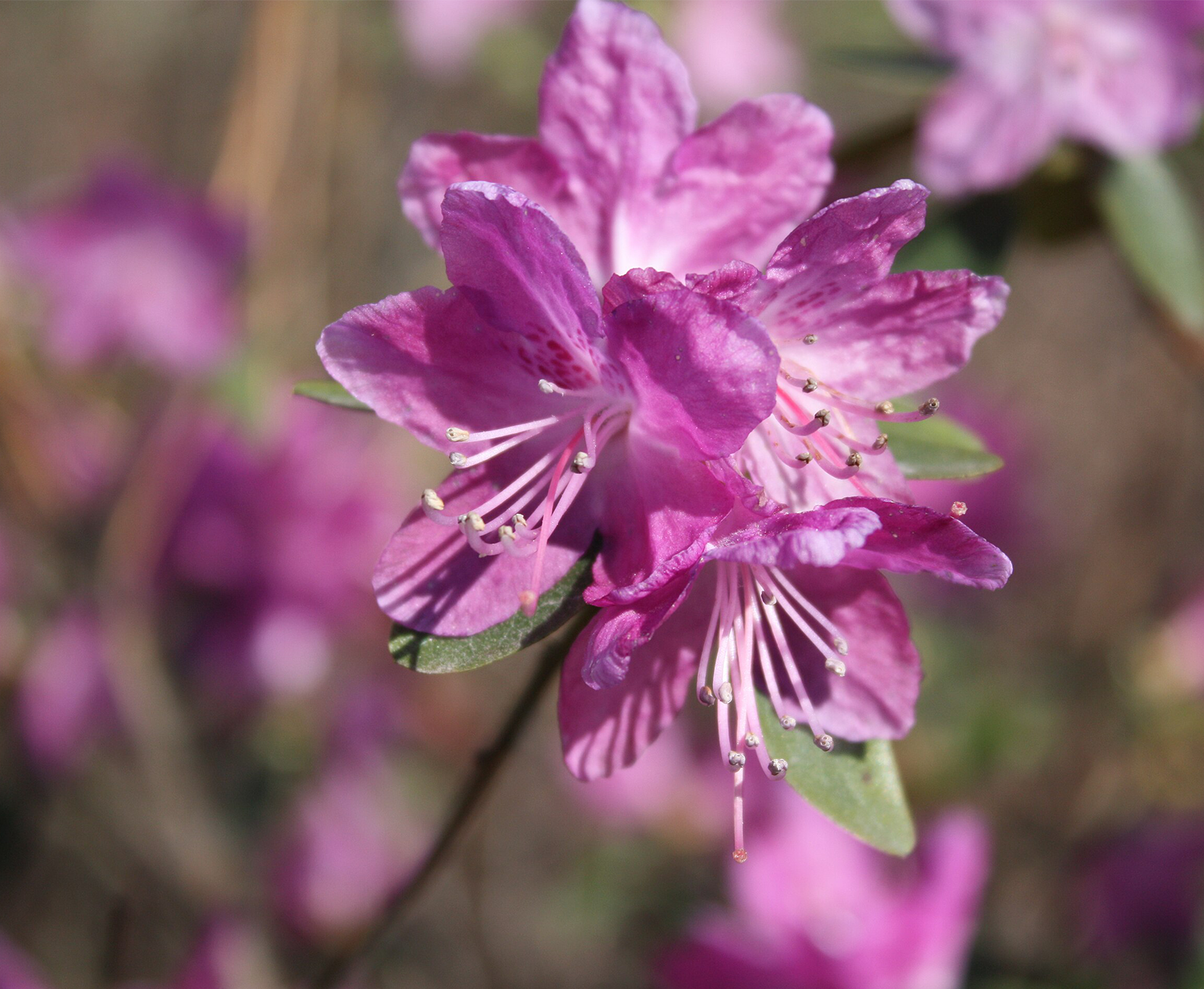
Categories: Research Articles 0 CommentsMan Shan Hong, the Chinese name for Rhododendron dauricum, yields a flavanone called farrerol. It works by switching on the cell’s own antioxidant machinery rather than by supplying antioxidants from outside, and that distinction is what makes it interesting to anyone studying aging.
The short version
Your cells do not rely on the antioxidants you eat. They make their own, and they make them on demand. A protein called Nrf2 sits in the cell waiting for a signal, and when oxidative stress rises it moves into the nucleus and switches on a whole battery of defensive genes at once: glutathione, superoxide dismutase, heme oxygenase-1, and a dozen more. One signal, a coordinated response.
What happens with age is not that the machinery disappears. It is that the response gets slower and smaller. Oxidant production climbs while the enzymes meant to handle it decline, which is one of the better-documented features of aging tissue.
Farrerol pushes on that switch. Laboratory work shows it raises Nrf2 along with the enzymes Nrf2 controls, and when researchers silenced Nrf2 the protection disappeared entirely. That last detail is what separates a real mechanism from a correlation: the effect did not merely travel alongside Nrf2, it depended on it.
What this adds up to: a compound from a plant with a long documented history of use in China acts on the inducible side of antioxidant defense, the side that weakens with age, rather than adding one more molecule to the pool. The sections below set out what has been shown, in what systems, and what has not been tested.
What makes this plant distinctive
Rhododendron dauricum L. is a member of the Ericaceae, known in traditional Chinese medicine as Man Shan Hong. Its characteristic constituent is farrerol, described in the literature as the typical natural flavanone isolated from the herb, and the plant is used in China for bronchitis and cough (Qin et al., 2022).
The rest of its chemistry is unusual enough to be worth noting. Phytochemical work on the species isolated four previously undescribed prenylated orcinol derivatives, named daurichromenes A through D, alongside the known compounds confluentin, grifolin and orcinol (Iwata et al., 2004). Grifolin in particular is more often associated with fungi, and finding it in a flowering shrub is the kind of detail that marks a plant as chemically unusual rather than merely another source of common flavonoids. Those compounds inhibited histamine release in the same study, which is consistent with the respiratory use the plant has long had.
Farrerol, though, is the compound with the deepest file, and it is the one that connects to aging biology.
Why Nrf2 is the mechanism that matters for aging
Increasing oxidative stress is a defining characteristic of aging, and the reason is not simply that more damage occurs. In aging tissue, oxidant production from several sources rises at the same time that antioxidant enzymes, the primary line of defense, decrease. Repair systems fall behind on both counts at once (Zhang, Davies and Forman, 2015).
Nrf2 is the transcription factor that governs the enzyme side of that equation. It is held inactive by Keap1 until oxidative or electrophilic stress releases it, at which point it induces the full antioxidant response. A compound that acts on Nrf2 is therefore not contributing a single antioxidant molecule. It is acting on the system that decides how much defense gets produced, which is a different and more upstream kind of intervention.
This is also why the distinction between consuming antioxidants and inducing them is not a semantic one. Dietary antioxidants are stoichiometric; one molecule neutralizes roughly one oxidant and is spent. Nrf2 induction is catalytic in effect, because the enzymes it produces keep working.
What farrerol has been shown to do
The 2022 review in Pharmaceutical Biology gathered a decade of work on the compound and found a consistent signature across models. On the antioxidant side, farrerol enhanced Nrf2, glutathione, superoxide dismutase, glutathione peroxidase, heme oxygenase-1 and NQO1 while reducing reactive oxygen species, malondialdehyde and NOX4. On the inflammatory side it inhibited IL-6, IL-8, IL-1β, TNF-α and NF-κB (Qin et al., 2022).
Those two lists are the reason this compound reads as aging-relevant rather than narrowly useful. Declining Nrf2 output and rising baseline NF-κB activity are the two halves of what the field calls inflammaging, and farrerol appears in the literature pushing both in the favorable direction.
The same review also catalogued vasoactive effects: increased eNOS, occludin, ZO-1, calmodulin and IP3R, with reduced mTOR, Jak2 and Stat3 signalling. Occludin and ZO-1 are tight junction proteins, eNOS produces the nitric oxide that keeps vessels dilated, and all three decline as vascular tissue ages. The review’s own conclusion is that farrerol warrants further study for vascular applications.
The experiment that establishes the mechanism
Breadth in a review is suggestive. A knockdown experiment is what makes a mechanism load-bearing, and farrerol has one.
Researchers pretreated mouse BV-2 microglial cells with farrerol and then exposed them to β-amyloid. Farrerol reduced reactive oxygen species and malondialdehyde, restored superoxide dismutase activity, and lowered the secretion and messenger RNA of IL-1β, IL-6 and TNF-α. It did this while promoting Nrf2 and suppressing Keap1. When Nrf2 was knocked down, the protective effect was abolished (Cui et al., 2019).
That last sentence is the whole value of the study. It rules out the possibility that farrerol was simply mopping up oxidants directly, in which case removing Nrf2 would have changed little. The compound was working through the pathway, not around it.
Microglia are also a sensible place to have found this. They are the brain’s resident immune cells, their shift toward a chronically activated state is one of the better-characterized features of the aging brain, and their oxidative output is part of what makes that state self-sustaining.
Who this matters to
This is a research file rather than a product. MDS Labs does not currently offer a Rhododendron dauricum preparation, and we publish compounds at this stage because the reasoning is worth following before anything is on a shelf.
It matters most to people tracking Nrf2 activators specifically. That category is small and the well-known members of it, sulforaphane among them, get most of the attention. Farrerol belongs in the same conversation on the strength of the knockdown data, and it comes from a plant with centuries of documented human use behind it, which is not true of every candidate in the category.
What has not been established
The antioxidant and anti-inflammatory results above come from cell and animal systems, with no controlled human trial of isolated farrerol published for any aging-related outcome, and no study has tested the compound against lifespan or any measure of biological age in a mammal.
Where this goes next
Our interest here is the comparison rather than the compound in isolation. Several botanical Nrf2 activators now have mechanistic data of this quality, and the question we care about is whether they converge on the same downstream enzymes or reach different parts of the response, because that determines whether combining them is additive or redundant. Our other research articles work through the same question for other compounds.
Citations
[1] Qin X, Xu X, Hou X, et al. The pharmacological properties and corresponding mechanisms of farrerol: a comprehensive review. Pharm Biol. 2022;60(1):9-16. PMID 34846222
[2] Iwata N, Wang N, Yao X, Kitanaka S. Structures and histamine release inhibitory effects of prenylated orcinol derivatives from Rhododendron dauricum. J Nat Prod. 2004;67(7):1106-9. PMID 15270561
[3] Zhang H, Davies KJA, Forman HJ. Oxidative stress response and Nrf2 signaling in aging. Free Radic Biol Med. 2015;88(Pt B):314-336. PMID 26066302
[4] Cui B, Zhang S, Wang Y, Guo Y. Farrerol attenuates β-amyloid-induced oxidative stress and inflammation through Nrf2/Keap1 pathway in a microglia cell line. Biomed Pharmacother. 2019;109:112-119. PMID 30396067
These statements have not been evaluated by the Food and Drug Administration. Nothing here is intended to diagnose, treat, cure or prevent any disease. Consult a healthcare professional before using any supplement, particularly if you take prescription medication.